Developing a Relational Model of Care for Older People by James Woodward Jenny Kartupelis
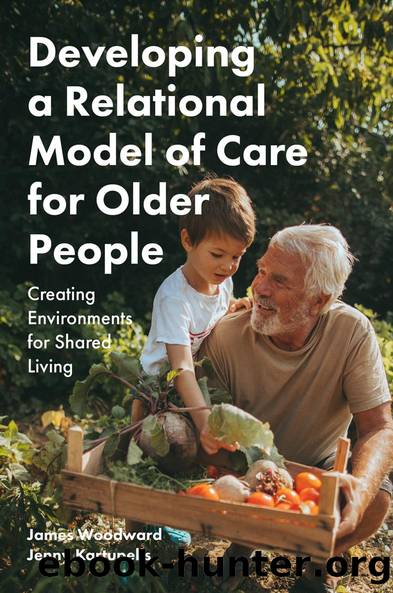
Author:James Woodward, Jenny Kartupelis [James Woodward, Jenny Kartupelis]
Language: eng
Format: epub
Tags: Social Science, Social Work, Family & Relationships, Eldercare, Gerontology, Medical, Nursing, Research & Theory, Management & Leadership, Business & Economics, Personal Finance, Retirement Planning, Neurology, General
ISBN: 9781784506551
Google: q19IDwAAQBAJ
Publisher: Jessica Kingsley Publishers
Published: 2018-05-21T05:29:51+00:00
The care home manager
So what happens to help the family bonds form, when indeed they do, which is not inevitable? The part played by environment, norms and attitudes has already been explored, but the role of the homeâs manager is arguably the most critical, both in creating the environment and acting as a catalyst for âmutual chaplaincyâ. They must set the tone, ensure that loving kindness can be expressed and acted out, be a mediator in times of conflict, decide what is tolerable and tolerated on a daily basis and what needs escalated action. This person requires a high degree of autonomy backed by support and development from the management or Trustees of the organisation, and a form of oversight that is positive but recognises where ultimate accountability lies.
This analysis might raise the question as to whether such paragons can be found. Clearly, they can, as hundreds of care homes and many thousands of staff and residents benefit from their presence, but it takes wise governance of a charity or business to recognise them, help them reach their full potential, and value them through fair pay, training and compassionate monitoring. This approach to all staff results in better retention and a secure and sustainable business model from which all participants can benefit.
Arguably in well-functioning homes there are two relational models running side by side, complementary and harmonious: one is the model of good employment and care provision practice, the other is the model of the âfamilyâ. So we see that both can blend together, for example, trustees overseeing the governance may become part of the âfamilyâ; more than one spoke of seeing the manager of a home as a âdaughterâ. There is also a blurring of lines between residents and volunteers insofar as the former may also take the role of the latter in terms of helping, listening, offering a lift to someone who doesnât have the bus fare, and in some larger homes taking a role such as running the shop or teaching a skill. This is very beneficial in helping people feel fulfilled and recognised as part of the social fabric.
One example of the critical part played by the manager as catalyst for mutual chaplaincy can be seen in issues relating to death and bereavement. During the interviews we considered how residents handled bereavement (and were helped in doing so), how it affected staff, what approach was taken to sharing news of loss and whether there was any opportunity for communal recognition.
How is spiritual life sustained in the face of death, where some people may have a profound faith and others none? Staff and managers generally felt that residents were reluctant to dwell on death when it occurred in the home. It is hard to establish if this is due to stoicism, or expectation that it would happen with increasing frequency, or to fear of the subject. Almost certainly, all these suppositions would apply to different people, some of whom were seen as âtaking it in their strideâ
Download
This site does not store any files on its server. We only index and link to content provided by other sites. Please contact the content providers to delete copyright contents if any and email us, we'll remove relevant links or contents immediately.
Spell It Out by David Crystal(36116)
Life for Me Ain't Been No Crystal Stair by Susan Sheehan(35810)
Cecilia; Or, Memoirs of an Heiress — Volume 1 by Fanny Burney(32558)
The Great Music City by Andrea Baker(32018)
Cecilia; Or, Memoirs of an Heiress — Volume 2 by Fanny Burney(31956)
Cecilia; Or, Memoirs of an Heiress — Volume 3 by Fanny Burney(31941)
Professional Troublemaker by Luvvie Ajayi Jones(29661)
The Secret History by Donna Tartt(19085)
We're Going to Need More Wine by Gabrielle Union(19045)
Twilight of the Idols With the Antichrist and Ecce Homo by Friedrich Nietzsche(18632)
All the Missing Girls by Megan Miranda(16023)
Cat's cradle by Kurt Vonnegut(15351)
Pimp by Iceberg Slim(14506)
For the Love of Europe by Rick Steves(14121)
Bombshells: Glamour Girls of a Lifetime by Sullivan Steve(14073)
Talking to Strangers by Malcolm Gladwell(13370)
Norse Mythology by Gaiman Neil(13363)
Fifty Shades Freed by E L James(13239)
The Social Justice Warrior Handbook by Lisa De Pasquale(12190)
